Medical Squid Is Back: 15 Years Later, a New Chapter Begins
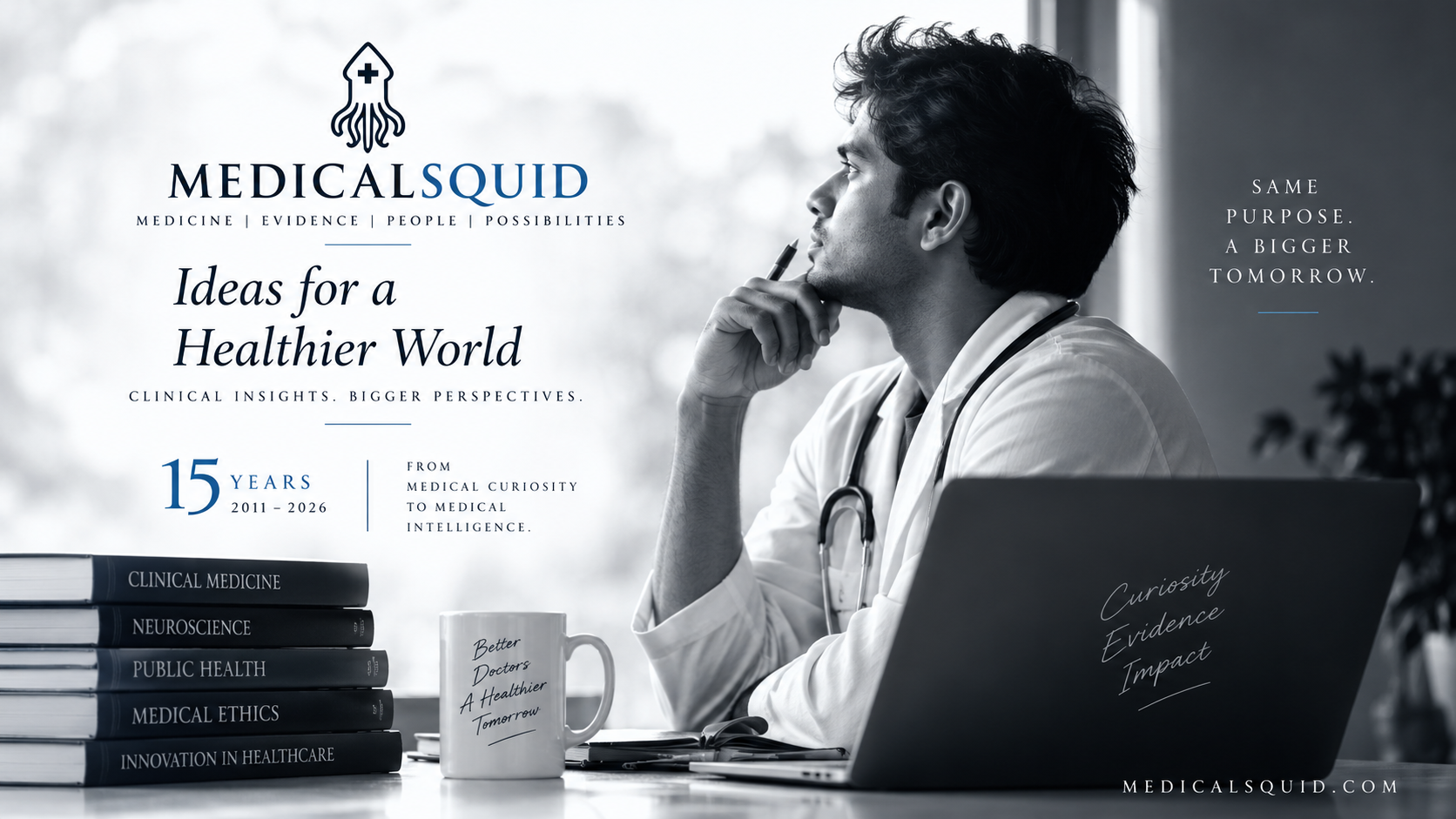
Medical Squid is back.
That feels slightly strange to write, because Medical Squid never completely went away.
The website started in 2011, during my residency years. Its Facebook page dates back to 9 March 2011. So in 2026, Medical Squid completes 15 years on the internet.
A lot has changed in those fifteen years—medicine, medical education, technology, the internet, and certainly my own journey as a doctor.
It feels like the right time to start writing here seriously again.
Medical Squid in 2011 was very different
My medical journey began with MBBS at Madurai Medical College. By the time Medical Squid came along, I had moved into residency and was living through the same entrance examinations, results, uncertainty and long working hours familiar to young doctors everywhere.
The internet of 2011 was very different too.
Running WordPress often meant downloading the files, uploading them to the server using FTP, configuring databases, experimenting with themes and plugins, and occasionally breaking the entire site late at night.
Internet meant BSNL broadband.
Hosting meant watching bandwidth and CPU limits.
And there were plenty of sleepless nights.
Medical Squid wasn’t created as a startup or media business. There was no content calendar, SEO team or monetisation plan.
We simply published things that seemed useful to medical students and young doctors.
Exams, NEET, court hearings and mock tests
A large part of the early Medical Squid revolved around medical entrance examinations and postgraduate medical education.
We covered entrance-exam announcements, counselling, results, NEET developments and important court hearings affecting medical students.
We also made previous examination papers freely available and created online mock tests that students could solve.
Today, medical entrance preparation is dominated by sophisticated apps, video platforms and enormous question banks. In 2011, useful material was much more scattered.
Sometimes the most useful thing a website could do was simply collect information and make it easy to find.
That was Medical Squid.
Remember waiting for AIIMS results?
Anyone who waited for competitive examination results in those years will remember the experience.
A result was announced.
Thousands of people tried to open the official website simultaneously.
And the server stopped responding.
Refresh.
Nothing.
Refresh again.
Still nothing.
On some occasions when AIIMS or other government servers struggled under the traffic, we mirrored important results or information so that students could access them.
Looking back, that tells me more about the original spirit of Medical Squid than any mission statement could.
Someone needed information.
We had access to it.
So we shared it.
The day DAMS sent us too much traffic
One particular memory from those days still makes me smile.
At one point, DAMS shared a Medical Squid link on its Facebook page.
Suddenly, our small website received a huge burst of medical-student traffic.
Soon afterwards, the hosting company sent a usage-limit warning.
Today, when we casually talk about scalable cloud servers and content-delivery networks, that sounds almost nostalgic.
Back then, I was delighted.
For a website being maintained between residency, studying and sleepless nights, hitting a hosting limit meant something very simple:
People were actually using it.
Then life became busier
Medical Squid gradually became quieter as medicine took over.
My journey expanded from residency into psychiatry, clinical practice, teaching and research. Training at AIIMS New Delhi shaped much of the way I think about clinical medicine and medical education.
Later, an MBA in Hospital and Health Systems Management added another dimension—healthcare operations, service quality, systems thinking and the realities of how hospitals actually work.
Over the years, my interests increasingly began to overlap:
psychiatry and neuroscience, medical education, evidence-based medicine, healthcare technology, hospital management, digital health and artificial intelligence.
Medical Squid remained somewhere in the background.
I never really decided to shut it down.
I simply stopped having enough time to give it the attention it deserved.
Why relaunch Medical Squid now?
Because the problem facing doctors has changed completely.
In 2011, the problem was often finding information.
In 2026, the problem is too much information.
Doctors now face a continuous stream of:
- new studies and clinical trials
- guidelines and consensus statements
- medical news
- diagnostic technologies
- health-tech products
- artificial-intelligence tools
- podcasts, videos and social-media opinions
- preprints and press releases
Finding information has become incredibly easy.
Understanding which information is important, credible and clinically useful has become much harder.
That is where I want Medical Squid to go next.
From medical news to medical perspective
The new Medical Squid will certainly continue covering interesting developments in medicine.
But I don’t want it to become another website that rewrites every new journal abstract into a headline.
The more useful questions are:
How good is the evidence?
Does this actually change clinical practice?
Is the difference clinically meaningful—or merely statistically significant?
Does a new technology genuinely improve care?
What does an AI system do well, and where can it go wrong?
What should a busy doctor actually take away from this?
Medical Squid should increasingly be about context and interpretation, not just information.
What I want to write about
The revived Medical Squid will reflect the areas I have spent the last fifteen years learning, practising and thinking about.
Medical education
Medical education itself is undergoing major change.
How should we teach medicine when information retrieval is instantaneous? What should examinations measure? How should doctors learn to use AI without outsourcing their clinical reasoning?
These questions interest me enormously.
Psychiatry and neuroscience
Psychiatry remains my primary clinical field, so expect plenty of writing around mental health, cognition, neuroscience, neuropsychology and emerging technologies in psychiatry.
Artificial intelligence in healthcare
AI in medicine deserves serious discussion beyond the usual question of whether it will “replace doctors.”
The more useful questions involve diagnosis, documentation, clinical decision support, medical education, research, ethics and patient safety.
Healthcare technology
New devices and digital platforms appear constantly.
Some may genuinely improve care.
Others simply make an ordinary idea look technologically impressive.
Medical Squid will try to distinguish between the two.
Hospital and health systems management
Good medicine does not exist independently of the system delivering it.
Waiting times, workflows, digital records, staffing, service design and patient experience all matter.
Healthcare management deserves more attention from clinicians.
Evidence and clinical updates
Interesting new research will continue to appear here—but with an emphasis on what the study actually tells us, its limitations and whether it should alter practice.
And there will always be room for medical law, ethics, careers, professional development and interesting ideas that don’t fit neatly into one category.
Medical Squid should have more than one voice
One thing I want to do differently this time is invite more people to write.
Medical Squid is now open to guest articles from medical students, residents, doctors, psychologists, researchers, medical educators and other healthcare professionals.
You don’t need to be a professional writer.
You may have an interesting clinical observation, an opinion about medical education, experience with a new technology, a research paper worth explaining, an unusual career path or simply something you have learnt that could help somebody else.
If it is original, thoughtful and useful, I would like Medical Squid to be a place for it.
Guest articles and collaborations:
medicalsquid@gmail.com
You can also follow Medical Squid on Facebook.
And the old Medical Squid deserves a place too
As part of this relaunch, I also want to gradually recover some of the old Medical Squid.
The entrance-exam pages, old question papers, mock tests, court-case updates and early medical articles are now pieces of internet history.
Some were once among the site’s most visited pages.
They obviously won’t be presented as current exam guidance, but I would like to preserve the best of them in a Medical Squid Archive.
There is something satisfying about a website now discussing AI in medicine preserving pages from an era when we were helping students access results from overloaded government servers.
Fifteen years later
Medical Squid began in a world of:
BSNL broadband. WordPress. FTP uploads. Shared hosting. Entrance examinations. Previous papers. Mock tests. Court hearings. Crashed servers. Sleepless nights.
Today, the conversations are different:
medical education, psychiatry, neuroscience, evidence, AI, healthcare technology and health systems.
But the basic instinct hasn’t changed much.
Find something interesting.
Understand it properly.
Share something useful.
Medical Squid | 2011–2026
15 years later, still curious.
From medical curiosity to medical intelligence.
Medicine. Evidence. People. Possibilities.